


"My Sin" (in the French original version: "Mon Peche") was the first successful perfume launched by Lanvin, the famous French fashion house, in 1924. At the top of success, in the early 1920s, Jeanne Lanvin decided to create her own Perfumes line, and entrusted this task to a mysterious lady of Russian origin: "Madame Zed", as she was known.
Madame Zed created fifteen different “Lanvin” fragrances over just two years, of which today we know virtually nothing but the names, then she disappeared into thin air.
"My Sin / Mon peche" was the only one of these fifteen fragrances to got a major success and a significant economic return, enough to convince Jeanne Lanvin to open her own perfumes production plant, and to entrust it to André Fraysse, who -just a few years later- created the masterpiece: "Arpege" (1927).
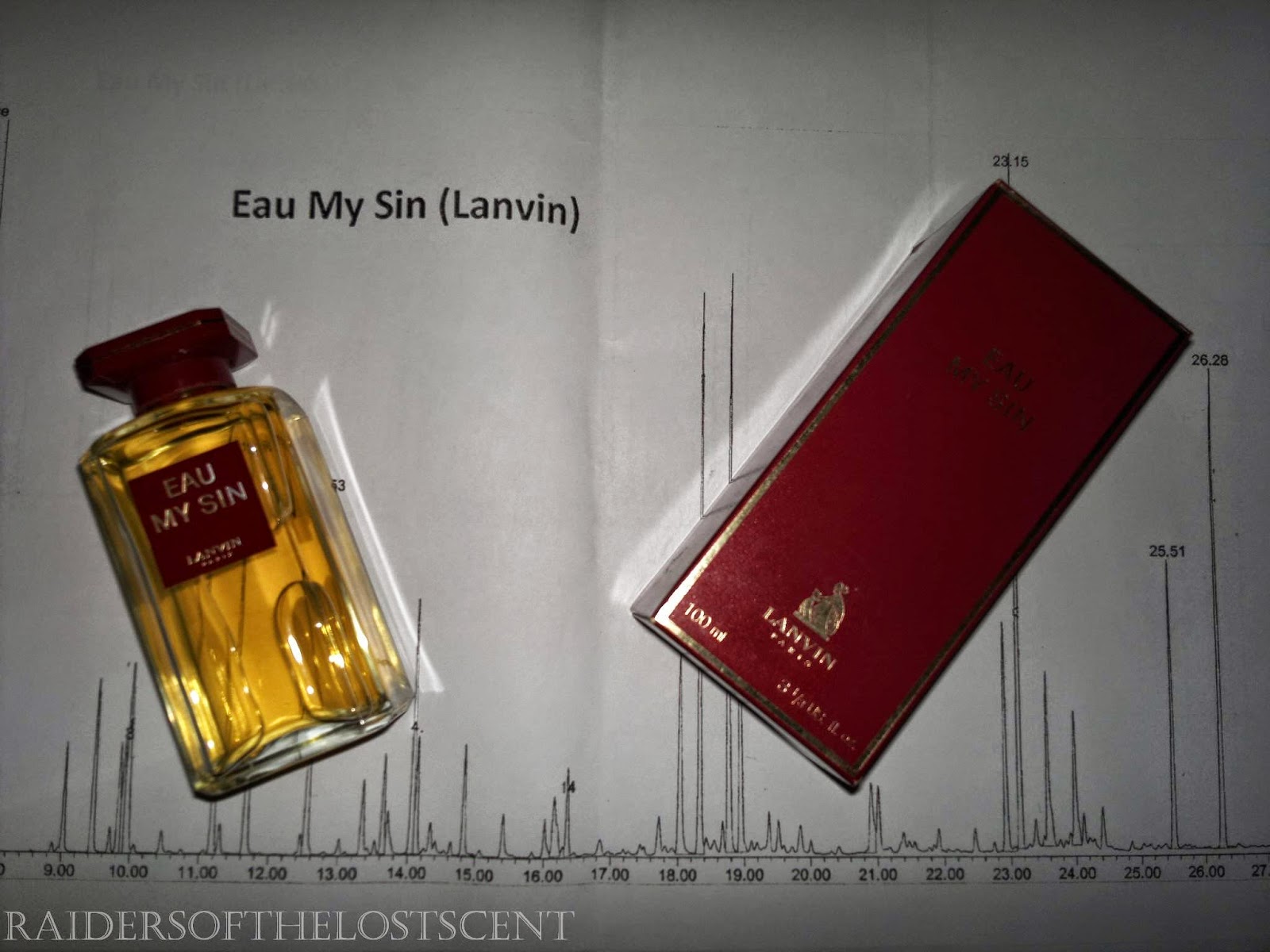
"My Sin" remained in production for more than sixty years before discontinuation, and now the latest version produced (1980s) will be examined via Gas-Chromatogaphy and Mass-Spectrometry (GC-MS).
"My Sin / Mon Peche" is one of the most famous fragrance of the 1920s, and it was obviously 'reformulated' several times during the following decades.
How will this scent perform over the GC-MS ?
Follow us and discover it!
(beware: 'My Sin' was reissued in recent times by another producer who bought the commercial rights, and put him back on the market).
The analysis was performed with Perkin –Elmer instruments and internal software libraries; the sample of “My Sin” was delivered anonymously, and no one was aware of it during the experiment; it was revealed only at the end of the experiment (blind test).
Data, as usual, were analyzed and discussed by Dr. Roberto Dario, chemist with several years of experience in the field.
Roberto Dario was very busy with his University lectures, but kindly cut out a couple of hours (an accurate analysis is time-consuming) for discussion of the GCMS, "crossing" data with olfactory impressions.
 |
| Dr. Roberto Dario smelling and checking a GS-MS |
Andre Moreau (AM) : "Good evening, Dr. Dario! We are here for the analysis and discussion of a masterpiece of old perfumery: it's "Eau My Sin" by Lanvin, in his late 1980s version, immediately before discontinuation".
Roberto Dario (RD) : "Good evening to you and to all our readers, we are ready, and I am also personally curious to know something more about this old scent, so let's go immediately: your GC-MS data on the desk, and a sample in front of us"

AM: "Before starting, however, it would be necessary a brief recap about the 'know-how’ of a scientific analysis of a perfume, performed in three stages.
The first stage is purely an olfactory one. We smell the test-strip (or 'mouillette') and take note of first impressions. A 'nose' (i.e an expert) averagely experienced will already be able to get a rough idea of the composition of a perfume.
The second stage is the analysis of instrumental data. The Gas-Chromatography Mass-Spectrometry (GC-MS) is the most important tool in perfumery, and although it may seem not-so-poetic, you can not perform a serious analysis without this instrument. The GC-MS, briefly, tells us which substances are *really* contained in the fragrance.
The third stage is the most important: the discussion. We take a new test-strip, and smell the perfume looking at the data, 'crossing' both the olfactory impressions and instrumental infos, to obtain a final verdict.
A really well-trained nose goes directly to the third stage, avoiding the first two: smelling and graphics analysis ‘crossed’ together in the same moment. But before reaching such levels you need years of training and experience ..... Ok, I leave room to Roberto Dario".

AM: "Well, this is something really unusual, because 'Joy' was released in 1930, while 'My Sin' was launched in 1924, at least five or six years before"
AM. "However, it seems a so-called ‘scent from another era’ ... "


AM: "... what?"
AM. "I think the most amazing thing is another: during the 1920s we had fragrances with a lot of naturals, yes, but in this case we are speaking about a bottle produced during the 1980s, and it is remarkable that ‘My Sin’ contains -still in the 1980s- natural ingredients in such large quantities, and of such great quality"


AM: "Could you see the 'Talc', looking at the chart ?
( beware: these perfumes are not for sale; no publicity intended; and in order to avoid problems due to copyrights, no exact formula will be publicly revealed )
(avvertenza: i profumi trattati non sono in vendita; non si intende far pubblicità ad alcun brand commerciale; tutti i protagonisti hanno partecipato in maniera disinteressata, senza percepire alcun compenso; infine, per motivi di copyright gli ingredienti completi e le quantità esatte non verranno esposte)
“My Sin” (nella versione francese “Mon Peche”) fu il primo profumo di successo lanciato dalla celebre casa di moda Lanvin, nel lontano 1924. All’apice del successo, all’inizio degli anni Venti, Jeanne Lanvin decise di lanciarsi nel campo dei profumi e affidò il compito a una misteriosa lady di origini russe di cui non si conosce altro che il nome d'arte, e praticamente nient'altro: “Madame Zed”.


AM: “Se andiamo a leggere sulla letteratura pubblicata sulla Rete, possiamo leggere che la ‘piramide olfattiva’ è enorme. My Sin sembra contenere Ylang-Ylang, Balsamo Tolu, Mughetto, Styrax, Vaniglia, addirittura Vetiver…”


EAU MY SIN (Lanvin, 1980s)
in sintesi:
RD : "Well, let’s break this rule immediately, giving a quick look at the GC-MS to verify the old ‘solvents trick’: if the data show us a vintage perfume containing several different solvents, we can assume it contains natural substances.
Solvents are used to solubilise, and natural substances are hard to solubilise. So, you need solvents. Modern perfumes don't need many solvents, being almost entirely synthetic, .
Solvents are used to solubilise, and natural substances are hard to solubilise. So, you need solvents. Modern perfumes don't need many solvents, being almost entirely synthetic, .
Now, let's go to and check it. Here we see several solvents: Isopropyl Myristate, Dipropylene Glycol, Ethoxyethanol .... So, even before start smelling, we can already say that 'My Sin’ contained natural substances, even during the 1980s."
AM: " Let's go to the next step ... "
RD : "Well, on the test-strip, during first minutes, we smell Rose and Jasmine, very, very intense. Immediately after that, we smell Lavender. Then, some light citrus and woody notes come out.
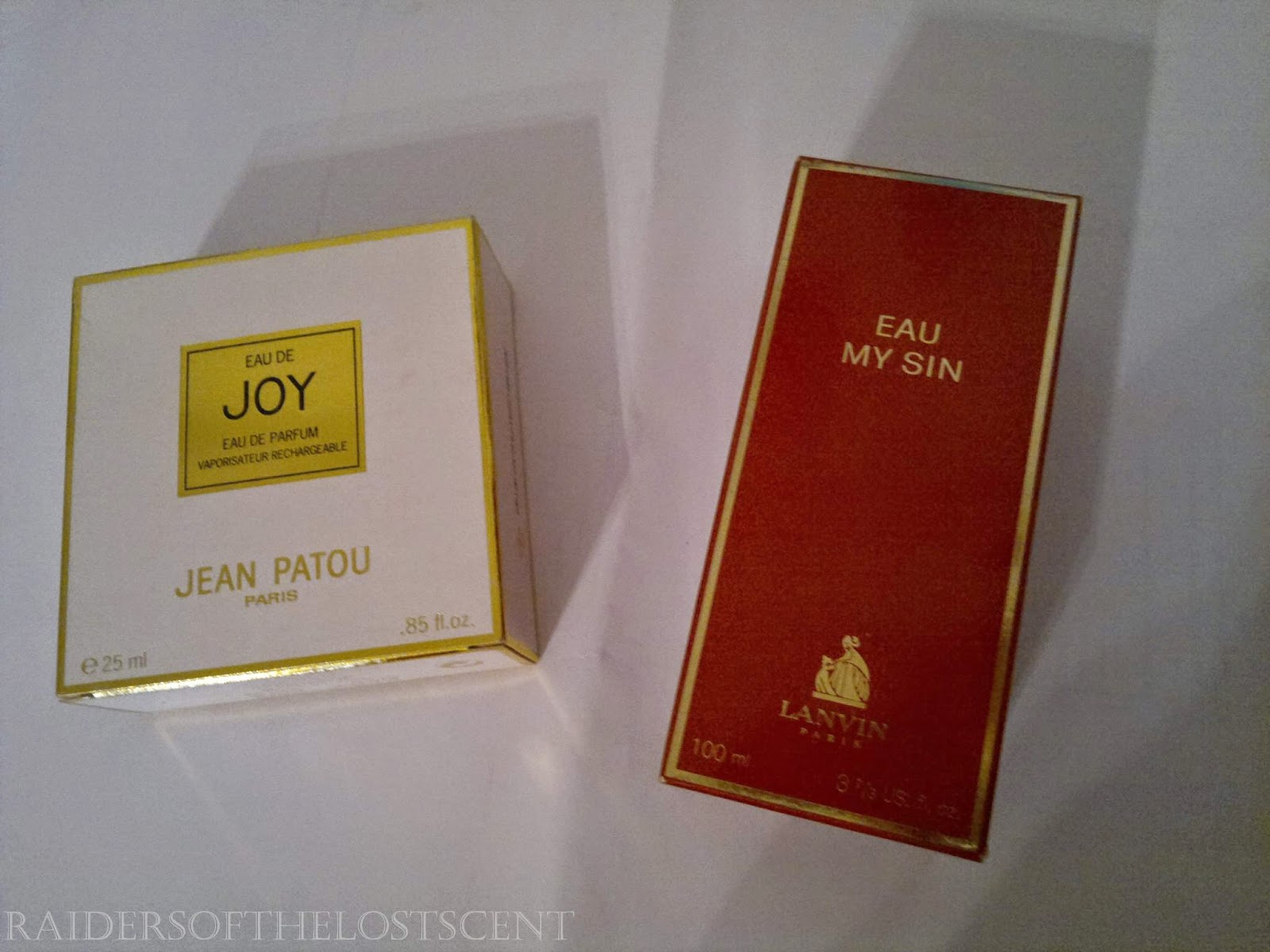
And here's just one remarkable thing. This scent is similar in structure and type, without being identical of course, to 'Joy' , the famous perfume by Jean Patou"
And here's just one remarkable thing. This scent is similar in structure and type, without being identical of course, to 'Joy' , the famous perfume by Jean Patou"
AM: "Well, this is something really unusual, because 'Joy' was released in 1930, while 'My Sin' was launched in 1924, at least five or six years before"
RD : "If I have to give credit to this sample from the 1980's (I cannot say anything about previous versions, of course: I can’t provide any comparison with 1950s, 1960s, 1970s samples), well, similarities are evident: ‘My Sin’ appears to be similar to ‘Joy’.
We could almost wonder if Henri Almeras, who created Joy in 1930, took inspiration from ‘My Sin’, that was a scent of success in those years".
AM. "However, it seems a so-called ‘scent from another era’ ... "
RD : "No doubt about it; when I smell this, in my mind I’m coming back to the 1920s, the ending of first World War, the Art-Deco style, silent movies, etc.
More than ‘an old times perfume', however, I would say 'a timeless one'. You see, ‘Joy’, ‘MySin’, ‘Arpege’, and many others, the classic scents that now appear ancient, dated, still retain a luxurious aura and exquisite 'classic style'.
‘My Sin’ is similar to ‘Joy’, not only with the structure but also with the quality; a trained nose recognize immediately a fragrance built with high quality materials.
Well, I’d dare to say, now, that the Rose, Jasmine, and Lavender here contained are natural ones, and in high quantities too. This scent is intense and concentrate."
AM: "Well. what about GCMS ? Confirmed or not? "
RD : " ... and yes, here it is: the Jasmine is confirmed by the presence of Benzyl Acetate, Benzyl Benzoate, and Benzyl Alcohol. It's confirmed, yes, we can say that here is real, natural Jasmine, and not the usual chemical replacers, or synthetic accords. For the Rose, even in bigger quantites! Phenethyl Alcohol, Citronellol, Geraniol, Geranyl Acetate. Hats off! It’s confirmed the presence of natural Rose, too. And what about the Lavender? We find the presence of Linalool, Linalyl acetate, and Alpha-Terpineol. And here we can say that it is natural Lavender.
Then we have a very light citrus background, with probable contributions of Citronellol, Acetonaphthone, and Methyl Anthranilate.
Then, there is a hint of woody notes, certainly due to Methyl Ionone Alpha, coupled with Methyl Ionone Gamma.
Briefly, here are the first things we smell, and subsequently confirmed by the instrument.
But the strangest thing is another ... "
AM: "... what?"
RD : "...but not too strange, maybe, since it's an old perfume. Looking at the graphs, these natural substances are present in very significant quantities. Nowadays, a scent like this simply does not exist; unless you have it produced by request, and paying a lot of money."
AM. "I think the most amazing thing is another: during the 1920s we had fragrances with a lot of naturals, yes, but in this case we are speaking about a bottle produced during the 1980s, and it is remarkable that ‘My Sin’ contains -still in the 1980s- natural ingredients in such large quantities, and of such great quality"
RD : "In theory I could agree, but actually I’m not very surprised: it's confirmed by literature that many 1980s perfumes (even the ones defined 'mainstream perfumes' nowadays) were produced in many cases with a quality that today we would define as ‘extraordinary’.
Smelling this fragrance I realize the quality of the ingredients used until 15-20 years ago. Actually, the most singular thing is the amount of naturals used: natural Rose and natural Jasmine appear to be used without economies.
And checking such large quantities shown on the graph, well, it is quite surprising".
AM: "Virtually ‘My Sin’ is a 'Rose and Jasmine concentrate'.... "
RD : "Yes, but there is another thing I would add…but I want to be sure about; so I prefer to wait a little before affirming it. I'll say it at the end."
AM: "Well, we started just minutes ago, and we can already say to have in front of us a perfume that exceeds in quality the majority of what's on the market today! "
RD : "These are the big surprises of the Perfume World! It 's nice to be surprised in this way... go with next notes now: uh, smell how beautiful and smooth this 'Talc' appear.
A strong Talcum Powder note that is coming out. Truly remarkable!"
A strong Talcum Powder note that is coming out. Truly remarkable!"
AM: "Could you see the 'Talc', looking at the chart ?
RD : "Are you kidding? Here it is, and do we want to exaggerate ? There are four, I mean four, different Musks, which contribute to give thickness and strenght to the Talc note. By the way, these are all Musks from old days. Namely: Musk Ketone, Musk Ambrette, Musk Lactone and Musk T, again, in big quantities.
So, the Talc note is provided by four different Musks, used simultaneously.
A Talcum powder note addressed by four different Musks: well, I have no more compliments! "
AM: "Let’s talk about the integrity: this perfume dates back to the 1980s, then to date (year 2014) is at least 25 or 30 years old. What can you say about the integrity ?
RD : "I would say that it is intact, not ruined; Rose and Jasmine both pushing heavy on paper; and graph peaks are sharp, well defined, typical of the scents that are not degraded or ruined. Although I have no comparation with previous years, this is still intact, in my opinion."
AM: "I don’t even try to imagine what this scent should have been in the 1930s or 1940s. We're talking about a reformulation dating back to the 1980s. Incredible. How did Lanvin maintain such high quality through decades remains a mystery. Or perhaps maintaining an high quality has never been a problem, at least until a few years ago.
But I would like to ask something: on the box there is no reference to ‘Eau de Toilette’ or ‘Eau de Parfum’, it’s simply written ‘Eau My Sin’, can you say which concentration would it be? "
RD : " Yes, it is very likely to be an EdP, you can smell roughly the concentration of a fragrance, this is definitely an EdP , there are too many facets and too high concentration.
Similar is the case of Jean Patou, where ‘Joy’ is the EdT, while 'Eau de Joy', is the EdP .
It is very likely that 'Eau My Sin' could be the EdP version . "
AM: " If we read the literature published on the web, we can see that the 'olfactive pyramids' (i.e top, middle and base notes) is huge. ‘My Sin’ seems to contain Ylang-Ylang, Tolu Balm, Lily of the Valley, Styrax, Vanilla, Vetiver ... "
RD : " I always say to be wary about the 'pyramids' published, because these pyramids often do not correspond to reality; sometimes, reported pyramids are completely different from a source to another, and you could read different 'pyramids' on different books or websites; and a lot of times 'pyramids' are only a marketing tool.
Here, just as an example, all these notes you listed are not revealed by the instrument, unless they have been used in amounts so low to not to be detected, but it’s hard to believe.
However, specifically for ‘My Sin’ I have to admit that the amount of Rose, Jasmine and Talc is so massive, overwhelming, that there is little room for anything else. There is a background, very light indeed, with citrus and woody notes.
For example, somewhere is reported 'My Sin contains Vetiver', but I can't simply smell any Vetiver and, actually, there is no Vetiver on GCMS data.
On the contrary, Lavender simply doesn't appear on several reported 'My Sin olfactive pyramids', but a trained nose can smell it behind the overwhelming Rose and Jasmine, and, in fact, Lavender it's confirmed by GCMS data.
And now, as a 'basenote', I can clearly smell the Civet"
For example, somewhere is reported 'My Sin contains Vetiver', but I can't simply smell any Vetiver and, actually, there is no Vetiver on GCMS data.
On the contrary, Lavender simply doesn't appear on several reported 'My Sin olfactive pyramids', but a trained nose can smell it behind the overwhelming Rose and Jasmine, and, in fact, Lavender it's confirmed by GCMS data.
And now, as a 'basenote', I can clearly smell the Civet"
AM : "I would also add that, during decades, it is possible that the perfume could have been reformulated. Some of the ingredients could have been added, deleted, or changed, in order to keep the aroma along with the historical times. Samples of the same perfume from two different decades, appear different or 'reformulated' .... but let's talk about this ingredient, a pillar in many classic vintage perfumes, namely the Civet. What about the GCMS?"
RD : "Actually the civet does not appear on the graph, in this case, because being a complex substance, not volatile and very heavy, it needs specific conditions to appear on the graph.
Well, this is one of those situations where the ‘Nose’ has its big importance
In this case, looking only at the data, we could say that Civet is missing: on the contrary, Civet - even if you do not see on the graph - is here, and smells clearly”
AM: "A frequently asked question: natural Civet and the synthetic one. Can a trained nose smell the difference?
RD : "Of course! It's a very clear difference. Here, in ‘My Sin’, you can smell -almost obviously- a natural Civet.
AM: "With the Civet found in the base notes, we arrived at the end, All right? By the way, what about that 'last thing' you wanted to say? "
RD : "Yeah, it 's about the Rose. I know this particular shade of Rose, and it is not the traditional 'Rosa Damascena' so often used in natural perfumes. This is an even more rare and valuable variety. It’s the ‘Rosa Centifolia' (or ‘Rose de Mai’ ).
To be completely sure about it, a few more chemical analysis should be performed, but I'm reasonably sure it's the rare ‘Rosa Centifolia’. Its fragrance is unique and shines out perfectly from the other roses.
Ok, at this point you can add this extra line: ‘My Sin’ contains not only a lot of naturals, but the 'Rosa Centifolia', a rare and precious variety".
AM "Ok, we arrived at the end. What's about the last line? I would define this scent as 'Roses and Jasmins lying on a bed of Talcum powder'...
RD "I am not such a poet! so, I'll call it in a simpler way: a magnificent perfume. And that's all."
AM "Ok, we arrived at the end. What's about the last line? I would define this scent as 'Roses and Jasmins lying on a bed of Talcum powder'...
RD "I am not such a poet! so, I'll call it in a simpler way: a magnificent perfume. And that's all."
 |
| The "Rosa Centifolia" (or "Rose de Mai") |
EAU MY SIN (Lanvin, 1980s) at a glance
- Contains natural Rose, Jasmine, Lavender and Civet.
- Rose and Jasmine used in massive quantities.
-Four different Musks contributing to a strong Talc Powder note.
-Contains the natural and precious "Rosa Centifolia"
( beware: these perfumes are not for sale; no publicity intended; and in order to avoid problems due to copyrights, no exact formula will be publicly revealed )
---------------------------------------------------------------------
------------------------------------------------------------------
ITALIAN VERSION
(avvertenza: i profumi trattati non sono in vendita; non si intende far pubblicità ad alcun brand commerciale; tutti i protagonisti hanno partecipato in maniera disinteressata, senza percepire alcun compenso; infine, per motivi di copyright gli ingredienti completi e le quantità esatte non verranno esposte)
“My Sin” (nella versione francese “Mon Peche”) fu il primo profumo di successo lanciato dalla celebre casa di moda Lanvin, nel lontano 1924. All’apice del successo, all’inizio degli anni Venti, Jeanne Lanvin decise di lanciarsi nel campo dei profumi e affidò il compito a una misteriosa lady di origini russe di cui non si conosce altro che il nome d'arte, e praticamente nient'altro: “Madame Zed”.
‘Madame Zed’ creò quindici differenti fragranze nell’arco di due anni, delle quali al giorno d’oggi non si sa quasi nulla se non i nomi, dopodichè scomparve.
“My Sin” fu l’unico di questi quindici profumi ad avere un forte successo e un notevole ritorno economico, tale da spingere Jeanne Lanvin ad aprire negli anni successivi un proprio laboratorio di produzione indipendente e ad affidarlo ad Andrè Fraysse, il quale appena un paio di anni dopo darà alla luce il capolavoro della casa: “Arpège”.
“My Sin” rimase in produzione per più di sessanta anni prima che la produzione venisse interrotta, ed è proprio l’ultima versione -risalente degli anni Ottanta- ad essere esaminata.
(attenzione: il profumo ‘My Sin’ è stato rieditato in tempi recenti da un altro produttore che ne ha acquistato i diritti e lo ha rimesso in commercio)
(attenzione: il profumo ‘My Sin’ è stato rieditato in tempi recenti da un altro produttore che ne ha acquistato i diritti e lo ha rimesso in commercio)
“My Sin/Mon Peche” è uno delle fragranze più rappresentative della profumeria degli Anni ’20, è stata ovviamente riformulata diverse volte nel corso dei decenni, e verrà analizzato al gascromatografo, con spettrometria di massa, in quella che è la sua ultima versione degli anni '80 originale di Lanvin, immediatamente prima della fine della produzione.
Come ne uscirà alla prova del GC-MS?
L’analisi è stata effettuata con uno strumento Perkin-Elmer e relativa libreria software interna, il campione di profumo è stato consegnato anonimamente, e nessuno è stato a conoscenza di cosa si trattava, se non a esperimento terminato.
L’interpreatazioni dei dati, come di consueto, è affidata al dr. Roberto Dario, chimico, con tanti anni di esperienza nel settore.
Roberto Dario è indaffaratissimo con la preparazione delle sue lezioni universitarie, ma gentilmente ritaglia un paio di ore (purtroppo un’analisi accurata e non superficiale richiede un certo tempo) per la discussione del cromatogramma, “incrociato” con l’analisi olfattiva di un campione.
|
| il dr. Roberto Dario 'prova' il profumo, incrociandolo con i dati di una GC-MS |
Andre Moreau (AM): “Buonasera dottor Dario, allora, siamo qui per l’analisi di una vecchia gloria della profumeria:“My Sin” di Lanvin, nella sua tarda versione degli anni ‘80, immediatamente prima della sua interruzione.”
Roberto Dario (RD): “Buonasera a lei e a tutti quelli che ci leggono, siamo pronti, e personalmente sono anche curioso di saperne di più su questo profumo, quindi mettiamoci subito all’opera: dati della GC-MS da una parte, e sample con mouillette dall’altra”
AM: “Prima di cominciare però, sarebbe una breve ricapitolazione di come si svolge, appunto, una analisi ‘scientifica’ di un profumo, che avviene in tre fasi.
La prima fase è quella puramente olfattiva. Si annusa la mouillette e si prende nota delle impressioni. Un naso mediamente esperto e abbastanza allenato è già in grado di farsi un’idea sommaria della composizione di un profumo già da questa prima fase.
La seconda fase è quella dell’osservazione dei dati strumentali. Il gascromatografo è lo strumento più importante che esista in profumeria, e benché possa sembrare poco poetico, non si può fare una analisi seria senza questo strumento. Il gascromatografo, in sintesi, ci dice quali sostanze sono *realmente* contenute nel profumo.
La terza fase è quella più importante. Si prende una nuova mouillette fresca, e si annusa osservando i dati, ‘incrociando’ le sensazioni olfattive e i dati strumentali, per ottenere un verdetto finale.
Un naso veramente ben allenato passa subito alla fase numero tre: mouillette e grafico insieme, e subito si arriva ai risultati. Ma per arrivare a simili livelli ci vogliono anni di allenamento e di esperienza…..La parola subito a Roberto Dario.”
RD: “Infrangiamo subito le regole allora, dando una veloce occhiata al grafico, per verificare il vecchio trucco dei solventi: se i dati ci dicono che nel profumo sono contenuti più solventi differenti, possiamo stare relativamente certi che sono contenute sostanze naturali. I solventi infatti, servono per sciogliere perfettamente tutte le sostanze dentro il profumo, e le sostanze naturali sono quelle che hanno più difficoltà a solubilizzare. I profumi moderni difficilmente hanno tanti solventi perché, essendo quasi interamente sintetici, non hanno necessità di scioglimento. Andiamo al dunque: cosa vediamo in questo grafico, ad una prima occhiata sommaria? Ecco qui diversi solventi: Isopropil Miristato, DiPropilen-glicole, Etossietanolo…. Insomma prima ancora di cominciare ad annusare, già possiamo dire che in ‘My Sin’ di Lanvin, ancora negli anni 80, vi erano sostanze naturali.”
AM: “Passiamo alla fase successiva…”
RD: “Sulla mouillette sentiamo subito Rosa e Gelsomino, molto intensi. Subito dietro, Lavanda. Ancora più defilati, leggerissimi, agrumi e note legnose. E qui c’è subito una cosa da notare. Questo profumo assomiglia molto in struttura e tipologia, senza ovviamente essere uguale, a ‘Joy’, il celebre profumo di Jean Patou”.
AM: “…e questa è una cosa davvero singolare, perché ‘Joy’è uscito nel 1930, mentre ‘My Sin’ è del 1924, uscito almeno cinque o sei anni prima...”
RD : “Se devo dar retta a questo sample degli anni '80 (nulla si può dire delle versioni precedenti, ovviamente, non avendole sottomano per fare un paragone) le somiglianze sono evidenti: mi sembra infatti di stare annusando una variante di Joy. Verrebbe quasi da dire che Henri Almeras, che creò Joy nel 1930, prese ispirazione proprio da My Sin, che era un profumo di grande successo all’epoca.”
AM. “ Comunque si sente che è un profumo d’altri tempi…”
RD: “Su questo non c’è dubbio, annusando questo profumo sembra di tornare agli anni ’20, allo stile Art Dèco, ai film muti. Più che d’altri tempi, però, direi profumo senza tempo, Joy, MySin, Arpege, questi sono i classici profumi che oggi sembrano datati, ma conservano un’aura lussuosa e raffinatissima. Se posso aggiungere, My Sin ha di simile a Joy non solo la struttura, ma anche la qualità; un naso allenato sente subito che questo è un profumo costruito con materiali di altissima qualità. Mi azzardo subito a dire che la Rosa, il Gelsomino, e la Lavanda qui presenti siano naturali, e presenti anche in grande quantità….”
AM: “Che cosa ci dice il gascromatografo? Conferma o smentisce?”
RD: “…e infatti ecco qui: per il Gelsomino è stata rilevata la presenza di Benzil Acetato, Benzil Benzoato, e Benzil Alcool. Non manca nulla, possiamo dire che qui c’è vero gelsomino, e non i soliti accordi chimici.
Per la Rosa, se possibile in quantità ancor maggiori, abbiamo Fenetil-alcol, Citronellolo, Geraniolo, Geranil acetato. Tanto di cappello, confermata anche la presenza di vera rosa.
Per la Lavanda che cosa abbiamo? Ci troviamo in presenza di linaloolo, linalil acetato, alfa-terpineolo. E anche per quanto riguarda la lavanda possiamo dire che è vera lavanda.
Poi abbiamo un contorno agrumato molto leggero, al quale contribuiscono probabilmente citronellolo, acetonaftone e metil-antranilato, chiaramente visibili sul grafico..
...e anche una sfumatura legnosa, dovuta certamente a metil ionone alfa insieme ametil ionone gamma. Insomma, quello che già si sentiva a naso, è confermato dallo strumento. Ma la cosa più singolare è un’altra… “
Per la Rosa, se possibile in quantità ancor maggiori, abbiamo Fenetil-alcol, Citronellolo, Geraniolo, Geranil acetato. Tanto di cappello, confermata anche la presenza di vera rosa.
Per la Lavanda che cosa abbiamo? Ci troviamo in presenza di linaloolo, linalil acetato, alfa-terpineolo. E anche per quanto riguarda la lavanda possiamo dire che è vera lavanda.
Poi abbiamo un contorno agrumato molto leggero, al quale contribuiscono probabilmente citronellolo, acetonaftone e metil-antranilato, chiaramente visibili sul grafico..
...e anche una sfumatura legnosa, dovuta certamente a metil ionone alfa insieme ametil ionone gamma. Insomma, quello che già si sentiva a naso, è confermato dallo strumento. Ma la cosa più singolare è un’altra… “
AM: “… e sarebbe?”
RD: “Sarebbe il fatto che, a guardare i grafici, queste sostanze naturali sono presenti in quantità notevoli. Al giorno d’oggi un profumo del genere semplicemente non esiste; a meno di non farselo fabbricare (pagando salato) su commissione.”
AM. “Credo che la cosa più stupefacente sia anche un’altra: non tanto il fatto che in un profumo degli anni '20 stiamo rinvenendo ‘sostanze naturali’, quanto il fatto che stiamo parlando di un profumo prodotto negli anni '80, nemmeno un vintage dell’epoca d’oro quindi, ed è singolare che My Sin contenga, ancora negli anni '80, ingredienti naturali in così gran quantità, e di così grande qualità.”
RD: “In linea di massima concordo, però in realtà la cosa non deve nemmeno stupire troppo, in letteratura è assodato –e chi è nell’ambiente lo sa- che ancora fino agli anni ‘80 i profumi (anche quelli che oggi verrebbero definiti ‘commerciali’, a larga distribuzione) erano in molti casi prodotti di una qualità che oggi si definirebbe straordinaria.
Annusando questo profumo mi rendo davvero conto della qualità dei prodotti che venivano impiegati ancora fino a non molto tempo fa. Forse, la cosa più singolare sono le quantità, Rosa e Gelsomino qui sono adoperati senza economie. Venire a leggere quantità così elevate, sul grafico, è abbastanza inaspettato, di questi tempi”
AM: “Praticamente My Sin è una spremuta di Rosa e di Gelsomino….”
RD: “Esatto, ma c’è un’altra cosa che vorrei aggiungere; vorrei però averne la certezza, preferisco aspettare ancora un po’ per dirla. Arriviamo alla fine e poi vedremo.”

AM: “Insomma, abbiamo cominciato da pochi minuti e già possiamo dire di avere davanti un profumo che supera in qualità la maggior parte quello che c’è in commercio oggi”
RD: “Eh, le grandi sorprese del mondo dei profumi.. E’ bello comunque rimanere sorpresi, in questo campo …andiamo avanti: sentite che bellissimo talco che sta venendo fuori. Notevolissimo.”
AM: “Si vede il ‘talco’, guardando il grafico?
RD: “E come no, ecco qui:vogliamo esagerare? sono presenti ben quattro diversi Muschi che contribuiscono a dare dare spessore all’effetto talco. Tutti muschi di un’altra epoca.
Precisamente abbiamo: Musk Ketone, Musk Ambrette, Musk Lactone e Musk T.
Ecco, per dare l’effetto talco sono stati capaci di usare quattro diversi muschi contemporaneamente: bè, ho finito gli aggettivi!”
Precisamente abbiamo: Musk Ketone, Musk Ambrette, Musk Lactone e Musk T.
Ecco, per dare l’effetto talco sono stati capaci di usare quattro diversi muschi contemporaneamente: bè, ho finito gli aggettivi!”
AM: “Parliamo dello stato di conservazione: questo profumo risale agli anni '80, ha quindi a tutt’oggi (2014) almeno 25 o 30 anni di età. Cosa si può dire dello stato di conservazione?
RD: “Io direi che è integro, rosa e gelsomino spingono con forza sulla mouillette, e dal grafico i picchi sono netti, ben delineati, e tipici dei profumi che non sono degradati. E' chiaro comunque che nei profumi vintage queste cose vanno prese con le molle, soprattutto se non si hanno punti di riferimento con lo stesso profumo delle decadi precedenti".
AM “Non oso pensare a cosa dovesse essere questo profumo negli anni ‘30 o ’40. Stiamo parlando di una riformulazione risalente agli anni 80. Verrebbe da chiedersi come abbia fatto Lanvin a mantenere una qualità così elevata attraverso decenni…o forse, mantenere una qualità elevata, non è mai stato un problema fino a poco tempo fa. Ricordiamo infatti che ancora negli anni '80 l'IFRA c'era, ma rimaneva nell'ombra....
Ma una cosa vorrei chiedere: sulla scatola non vi è alcun riferimento a Eau de Toilette oppure Eau de Parfum, è semplicemente scritto “Eau My Sin”, è possibile sapere di quale gradazione possa trattarsi?”
Ma una cosa vorrei chiedere: sulla scatola non vi è alcun riferimento a Eau de Toilette oppure Eau de Parfum, è semplicemente scritto “Eau My Sin”, è possibile sapere di quale gradazione possa trattarsi?”
RD: “Sì, è molto probabile che sia un EdP, già si sente al naso la concentrazione di una fragranza, questo è sicuramente un EdP, troppa ricchezza di materiali. troppa concentrazione, troppe sfaccettature. Così come accade con i profumi di Jean Patou, dove “Joy” è l’EdT, mentre ‘Eau de Joy’, è l’EdP.
Similmente, è probabile che ‘Eau My Sin’, sia la versione EdP.”
AM: “Se andiamo a leggere sulla letteratura pubblicata sulla Rete, possiamo leggere che la ‘piramide olfattiva’ è enorme. My Sin sembra contenere Ylang-Ylang, Balsamo Tolu, Mughetto, Styrax, Vaniglia, addirittura Vetiver…”
RD: “Dico sempre di diffidare delle piramidi olfattive pubblicate, perché molte volte non corrispondono alla realtà, in molti casi se ne trovano pubblicate diverse, completamente differenti l’un l’altra, e molte volte sono uno strumento di marketing. Ecco, solo per fare un esempio tutte queste cose che lei ha appena elencato non risultano dallo strumento, a meno che non siano state utilizzate in quantità talmente basse da non venir rilevate, ma la vedo difficile come ipotesi.... Al naso comunque non risultano, però devo ammettere anche che la quantità di rosa, gelsomino e talco utilizzate è talmente massiccia che c’è poco spazio per altro. C’è un sottofondo, molto leggero, agrumato e legnoso.
Comunque per fare un esempio, in molte reviews leggiamo che in 'My Sin' è presente Vetiver, ma io qui il Vetiver non lo sento, e del resto, lo strumento non ci dice nulla a proposito di presenza di Vetiver....
Al contrario quasi da nessuna parte è riportata la Lavanda, eppure un naso ben allenato, dietro l'ondata di Rosa e Gelsomino, avverte che la Lavanda c'è, e la presenza nè è confermata tramite GCMS.
Ecco, nelle note di fondo comincia a sentirsi lo Zibetto.”
Comunque per fare un esempio, in molte reviews leggiamo che in 'My Sin' è presente Vetiver, ma io qui il Vetiver non lo sento, e del resto, lo strumento non ci dice nulla a proposito di presenza di Vetiver....
Al contrario quasi da nessuna parte è riportata la Lavanda, eppure un naso ben allenato, dietro l'ondata di Rosa e Gelsomino, avverte che la Lavanda c'è, e la presenza nè è confermata tramite GCMS.
Ecco, nelle note di fondo comincia a sentirsi lo Zibetto.”
AM: “Vi sarebbe anche da aggiungere che nel corso dei decenni è possibile che i contorni di un profumo siano cambiati. Può darsi che alcuni ingredienti siano stati aggiunti oppure eliminati o ridimensionati, al fine di tenere l’aroma al passo con i tempi. Non sarebbe la prima volta che lo stesso profumo, in due decenni differenti, si presenti in veste olfattiva leggermente diversa .Le famose 'riformulazioni', insomma.….ma ecco, parliamo un attimo dell’ingrediente classico in molti profumi vintage, è proprio lo Zibetto. Ma risulta sul grafico?”
RD: "In verità lo zibetto molte volte non risulta sul grafico, perché essendo una sostanza complessa, poco volatile e assai pesante, ha bisogno di condizioni di analisi particolari per comparire. Ecco, questa è una di quelle situazioni in cui è importante che oltre al gascromatografo sia presente anche il ‘naso’ per confermare e completare i dati. In questo caso, guardando solo i dati, avremmo potuto dire che in questo profumo lo zibetto non c’è: e invece lo zibetto -anche se non si vede sul grafico- c’è, e si sente."
AM “Una domanda che viene rivolta frequentemente: si discute molto di Zibetto naturale e Zibetto sintetico. Si sente la differenza al naso?
RD: “Ma scherziamo? E’ una differenza nettissima. Questo, in 'My Sin', è lo zibetto naturale, ma forse non c’era neanche bisogno di dirlo.
AM: “Con lo zibetto nelle note di fondo, siamo arrivati alla fine, presumo? Quale era quella cosa che avevamo lasciato in sospeso, e che voleva dire per ultima?”
RD: “Già, si tratta della Rosa. Il fatto che questa sfumatura di rosa la conosco, e non è la tradizionale ‘Rosa Damascena’, è una varietà se possibile ancor più preziosa, è la ‘Rosa Centifolia’ (o 'Rose de Mai'). Per averne la certezza bisognerebbe fare delle analisi particolari, ma sono ragionevolmente sicuro che sia proprio questa varietà. Il suo profumo è particolare, molto soave, e si distingue perfettamente dalle altre rose. Aggiungiamo pure questo: 'My Sin' contiene una rosa naturale, per di più di grande pregio:; la Rosa Centifolia”.
AM: "Per concludere il tutto, come potremmo riassumere 'My Sin' in una frase? Personalmente lo definirei: Un bouquet di Rose e Gelsomini, adagiati su un letto di Talco."
RD: "Io non sono un poeta come lei! Mi accontenterò pertanto di definirlo in maniera più semplice: un profumo magnifico."
AM: "Per concludere il tutto, come potremmo riassumere 'My Sin' in una frase? Personalmente lo definirei: Un bouquet di Rose e Gelsomini, adagiati su un letto di Talco."
RD: "Io non sono un poeta come lei! Mi accontenterò pertanto di definirlo in maniera più semplice: un profumo magnifico."
 |
| The Rosa Centifolia |
EAU MY SIN (Lanvin, 1980s)
in sintesi:
- Contiene Rosa, Gelsomino, Lavanda e Zibetto naturali.
- Rosa e Gelsomino presenti in quantità elevate.
- Una nota Talco è data dall'unione di quattro diversi muschi.
- Contiene la pregiata "Rosa Centifolia"
-----------------------------------------------------------------
-----------------------------------------------------------------


