raidersofthelostscent

  • Subscribe to our RSS feed.
  • Twitter
  • StumbleUpon
  • Reddit
  • Facebook
  • Digg
Showing posts with label Yves Saint Laurent. Show all posts

Wednesday, 9 December 2015

CINESCENT, by Gabriela Guidetti: "Opium" VS. "Gilda".

Posted on December 09, 2015 by niten

Opium (1977) 
vs 
Gilda (1946)

Mundson: "Gilda, are you decent?"
Gilda: "Me? Sure ... I'm decent." 
(from "Gilda", 1946)

When Pierre Dinand, creator of the first bottle of Opium, asked Yves Saint-Laurent his thought about "Orient", he answered: "Flowers of fire". Whether it's a reference to fireworks, born in the Far East, or to the visual effect you get when you close your eyes and press the eyeballs with your fingers, it does not matter, because in those few words Saint-Laurent synthesized the olfactive essence of the masterpiece created in 1977 by Jean-Louis Sieuzac for the Parisian maison.


As the flower represents the elegance and beauty of femininity blossoming in a myriad of colors, similarly the fire enhances the passionate and seductive side of every woman. Hot sensuality intoxicating without compromise, enclosed in an extremely complex and rich olfactory pyramid (unfortunately having little in common with the current version on the market) a "reformulated" fragrance that's much less intense than the original concept. But remember, great Classics are ageless, and always fascinate us. Such as certain movies that we can define "vintage", only because they are part of  long-past times. Such as certain flowers of fire, having the feature of a perturbing and dangerous femme fatale. Like Rita Hayworth in "Gilda". 
watch the movie


"Gilda" is a noir directed by Charles Vidor in 1946. Smoky nightclubs, dangerous business, gambling houses, underworld, sparkling luxury and betrayals flow with the troubled love story of Gilda (Rita Hayworth) and Johnny (Glenn Ford), until the so much longed happy end. Rita passes through the movie with the flaming determination of a dark lady that leaves no prisoners on her way, but only victims, due to her narcotic charm. She slowly slides off a long black silk glove from pale arms, or rolls her head back in a whirlwind of red hair, to damn the man who is watching her, forever.
It's just the first sequence in which Rita appears to seem soffused with the sensual fragrance of Opium.


Ballin Mundson, Gilda's husband, wants to surprise his friend and assistant Johnny and takes him to meet a guy. They enter a room with a song played by the radio in the background. Gilda, are you decent? Ballin asks. Me? She replies. The woman appears, like a dazzling vision. 


Red hair, uncombed in soft waves, frame her face. Amazed and bright gaze. Scent of juicy mandarin and aromatic myrrh envelops her body. Pungent shades of cloves and cinnamon flame the sweet lily of the valley. Fruity and spicy notes warm the sequence that vibrates with magnificent femininity. It only takes a few looks between Gilda and Johnny to understand that in the past they had a romantic liaison. Shock and astonishment in his eyes. A thrill in her eyes. Now she is Ballin's wife. 


Time stands still, hearts beat fast. The fragrance melts within petals of opulent and luxurious flowers, jasmine and carnation. Gilda's glaze has got the languid intensity of never appeased love. Golden and hypnotic resins penetrate the magnificence of flowers. The die is cast. "Johnny"....Gilda repeats with closed eyes and half-open mouth as a sign of scorn and defiance. The game is changing into a sensual jeu à deux where every move appears risky, complex and fascinating. And at this point the basenotes of Opium finally emerge, deep and passionate. Incense, amber, musk, sandalwood, vanilla come together in an intense and warm blend that hugs  Gilda's skin, brushes her, and -as a spiral of smoke from her cigarette- expands in heady and elusive fragrant waves. 


The powerful scent of Opium is a seductive net that traps nose and heart, as well as Gilda catches Johnny in the meshes of a sensuality without limits. The "Flowers of fire" burn in a multitude of velvety, carnal and spicy notes, velvety as Gilda's skin, carnal as her gaze, and spicy as her rebel red hair. And despite your tries, you will not be able to easily get rid of this perfume that will take your soul. 
As Gilda's hypnotic smile.

Previous chapters:
-Vetiver de Guerlain VS Steve McQueen
- Murasaki (Shiseido) VS Dressed to Kill (Brian de Palma)
- White Linen (Estèe Lauder) VS Out of Africa (Sidney Pollack)
- Angel (Thierry Mugler) VS Chocolat (Lasse Hallstrom)


Opium - Yves Saint-Laurent (1977)
Eau de toilette
Nose: Jean-Louis Sieuzac
Bottle designed by Pierre Dinand
Family: Oriental spicy
Olfactory Pyramid: Opium has got a very complex olfactory pyramid including 
notes of incense, cloves, cinnamon, lily of the valley, carnation, jasmine, myrrh, amber, mandarin, bergamot, vanilla, sandalwood, musk, oppoponax.


Gilda - Charles Vidor (1946)
Cast: Rita Hayworth Gilda; Glenn Ford: Johnny Farrell: George Macready: Ballin Mundson
Photography: Rudolph Mate
In 1946 the movie was entered into Cannes Film Festival
In 2013 it was included in the National Film Registry of the Library of the United States Congress.


---(italian)------------------------------------------------------------------

Opium (1977) Vs Gilda (1946)

Mundson: Gilda, are you decent?
Gilda: Me? Sure...I'm decent 
(from Gilda, 1946)

Quando Pierre Dinand, il creatore del primo flacone di Opium, chiese a Yves Saint-Laurent quale fosse la sua idea di Oriente, lo stilista rispose: fiori di fuoco. Che fosse un riferimento ai fuochi pirotecnici nati nelle lontane terre d'oriente o all'effetto visivo che si ottiene quando si chiudono gli occhi e si premono i globi oculari con le dita, non importa; perché in quelle pochissime parole Saint-Laurent aveva sintetizzato l'essenza stessa del capolavoro olfattivo creato nel 1977 da Jean-Louis Sieuzac per la maison parigina.
Se il fiore rappresenta l'eleganza e la bellezza della femminilità che sboccia in una miriade di colori, così il fuoco esalta il lato più passionale e seducente di ogni donna. Sensualità rovente che inebria senza compromessi, racchiusa in una piramide olfattiva estremamente complessa e ricca, che ha poco a che vedere con la versione attualmente in commercio, profumo riformulato e molto meno intenso del concept originale. Ma si sa che i classici non hanno età e che affascinano sempre. Come certe pellicole che possiamo definire vintage solo perché fanno parte di un periodo lontano dal nostro. Come certi “fiori di fuoco” che assumono i tratti conturbanti e pericolosi di una femme fatale. Come Rita Hayworth in Gilda. Gilda è un film noir diretto da Charles Vidor nel 1946. Fumosi locali notturni, affari pericolosi, bische, malavita, lusso scintillante e tradimenti accompagnano la tormentata storia d'amore di Gilda (Rita Hayworth) e Johnny (Glenn Ford), fino al sospirato epilogo. Rita attraversa il film con la fiammeggiante determinazione di una dark lady che non lascia prigionieri al suo passaggio, ma solo vittime del suo fascino narcotico. Basta che faccia scivolare lentamente un lungo guanto di seta nera dalla candide braccia o rovesci la testa all'indietro in una turbinio di capelli fulvi per portare alla dannazione per sempre l'uomo che la sta guardando.
Ed è proprio la prima sequenza del film in cui appare che sembra intrisa della sensuale fragranza di Opium.
Ballin Mundson, il marito di Gilda, vuole fare una sorpresa all'amico e collaboratore Johnny e lo porta a conoscere una persona. Entrano in una stanza da cui escono le note di una canzone suonata in radio. Sei vestita, cara? chiede Ballin. Io? Risponde lei. E appare, smagliante come una visione. I capelli sciolti in morbide onde le incorniciano il viso. Lo sguardo stupito e luminoso. Effluvi di succoso mandarino e di mirra aromatica la avvolgono. Il soave mughetto si accende dei toni pungenti dei chiodi di garofano e della cannella. Note fruttate e speziate scaldano la sequenza che vibra di magnifica femminilità. Bastano pochi sguardi tra Gilda e Johnny per capire che tra i due in passato era nata una liaison. Turbamento e sorpresa negli occhi di lui. Un fremito negli occhi di lei. Ora è la moglie di Ballin. Il tempo si ferma, i cuori battono forte. La fragranza si scioglie tra i petali di fiori opulenti e lussuosi, gelsomino e garofano. L'espressione di Gilda ha la languida intensità di un amore mai sopito. Resine dorate e ipnotiche si insinuano tra la magnificenza dei fiori. Il dado è tratto. Johnny.... ripete Gilda con gli occhi chiusi e la bocca semiaperta, in segno di scherno e sfida. Il gioco si sta trasformando in un sensuale jeu à deux dove ogni mossa appare rischiosa, complessa e affascinante. Ed ecco che compaiono le note di fondo di Opium, profonde e passionali. Incenso, ambra, muschio, legno di sandalo, vaniglia si fondono in un blend intenso e caldo che abbraccia la pelle di Gilda, la accarezza e come le volute del fumo della sua sigaretta, si espande in onde profumate impetuose e inafferrabili. La potente traccia olfattiva di Opium è come una rete seduttiva che imprigiona naso e cuore, così come Gilda intrappola Johnny nelle maglie di una sensualità senza limiti. I fiori di fiamma bruciano in una miriade di note vellutate, carnali e speziate, vellutate come la pelle di Gilda, carnali come il suo sguardo e speziate come i suoi ribelli capelli fulvi. E per quanto ci proviate, non riuscirete facilmente a sbarazzarvi di questo profumo che vi prenderà l'anima. Come il sorriso ipnotico di Gilda.

Opium – Yves Saint-Laurent 1977
Eau de Toilette
Naso: Jean-Louis Sieuzac
Bottiglia disegnata da Pierre Dinand
Famiglia: Orientale speziata
Piramide Olfattiva: Opium ha una piramide olfattiva molto complessa in cui emergono 
note di incenso, chiodi di garofano, cannella, mughetto, garofano, gelsomino, mirra, ambra, mandarino, bergamotto, vaniglia, legno di sandalo, muschio, oppoponax.

Gilda – Charles Vidor 1942
Cast: Rita Hayworth: Gilda; Glenn Ford: Johnny Farrell: George Macready: Ballin Mundson
Fotografia : Rudolph Mate
Il film fu presentato in concorso al Festival di Cannes del 1946.
Nel 2013 è stato incluso nel National Film Registry della Biblioteca del Congresso degli Stati Uniti d'America.

Read More
Posted in Gilda, Opium, Rita Hayworth, Yves Saint Laurent | No comments

Wednesday, 16 September 2015

YVES SAINT LAURENT "La Collection": a side-by-side comparison.

Posted on September 16, 2015 by niten


Since the launch, happened in 2011,  the "Yves Saint Laurent La Collection" (eight historic male and female perfumes) arose an huge amount of debate among perfume lovers.  The bigger complaint were about the "reformulation" of all eight scents made by L'Oreal (owner of YSL brand); then there was a minor complaint about the new "double cube" bottle (an identical one, for all eight scents), and -at last- the biggest cry: the stop of production of previous versions. 
Aesthetical considerations apart, what about these "new" scents? 
Was "reformulation" so drastic? 
Are these "new" perfumes so "awful" (as reported by many during past years), or "acceptable", or even "good ones"?
I was able to obtain all perfumes both in vintage and modern versions, and perfectly stored (especially the vintage ones). 
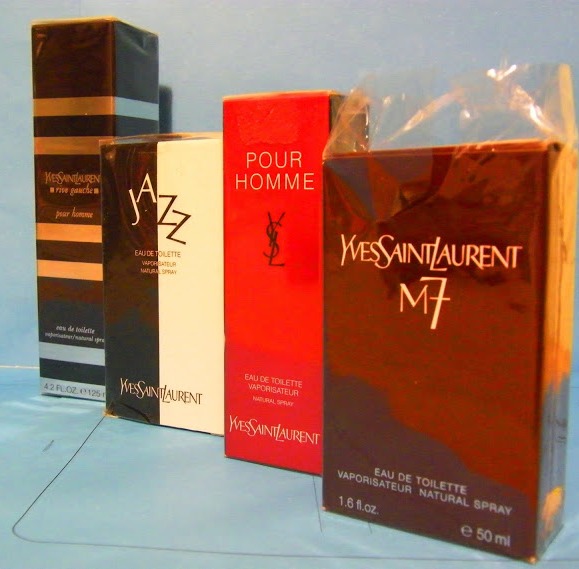
So, finally I could perform a side-by-side test with the four "new" male scents produced under "La Collection" line: Rive Gauche - JAZZ - YSL pour Homme - M7 Oud Absolu, and I compared with different "vintage" versions, under strict conditions.
How did they perform?
Let's go and discover it!


(Foreword: in this review I tried to compare accurately 4 different scents, using a great number of old and modern bottles. I tried firmly to be impartial, and without bias. I have no interest in describing ingredients and top and base notes, since you can read tons of reviews all over the Net. 
I'm more interested in describing "differences and similarities").
For understanding of various YSL eras and batch codes, see HERE)  


"La Collection" line: the front side of the four male scents

"La Collection" line: the back side.
from left: Rive Gauche - JAZZ - YSL pour Homme - M7 OudAbsolu

"La Collection" line: the bottom of each scent. 
It's clearly visible the batch code 62Hxxx. Letter "H" means "year 2011"


----------------------
MATERIALS  
and  METHODS
---------------------

For convenience only, here you can read and see pictures  of "M7" and "M7 Oud Absolu". An identical procedure was followed for other three scents.

All comparisons were made separately, to not to mix various scents and smellings. 
All comparisons were made inside a clean, no-windows, odorless room.
All comparisons were made at the same temperature: 20°C / 70 F.

As First step, the "paper strip test" was performed. Each scent was closely sprayed over the paper, and two strips were compared at different times. 

Step 1: Paper strip Test

The Second step was the "skin test". It consists in closely spraying scents separately on my own skin (I prefer back of my hands), and smelling over the hours.
Step 2: Skin Test

Third and final step was the "clothes" test. Both scents were closely sprayed on two pieces of heavy fabric, and evolution was observed. Heavy fabric "traps" an enormous quantity of molecules (much more than paper) and it is really effective if you want to observe even minimal differences.

Step 3 : Heavy fabric test

---------------------------
RESULTS
---------------------------

JAZZ

First perfumes considered was JAZZ, the famous one from the Eighties. YSL's Jazz was a perfume to write volumes about, but this is out of our intentions here. 
What about Jazz side-by-side comparison "yesterday and today"? Well, answer is not so simple. If you compare the new "La Collection" version with the most recent one (the bottle with clear, transparent glass, especially the ones produced after year 2000), you will hardly find any difference. Actually, both versions smell exactly the same. 
But if you compare the new "La Collection" version with most ancient bottles, i.e. the magnificent postmodern "Memphis-style" plastic ones, well, you will definitely notice a few differences. Old juice is "darker", heavier, thicker, more intense, deeper. The new one (i.e. "La Collection"), on the contrary, is almost "gentle", refined, lighter, "brighter". The only exceptions are clear bottles produced before or immediately after year 2000, still apparently retaining "vintage" juice.
Please don't misunderstand my words: this is still JAZZ in every version tested, and you will immediately recognize it. So, if you liked vintage JAZZ, you will appreciate the new one, too. 
But there are definitely differences between two scents.
What's the best? Personally I'm fond of old, classic black&white JAZZ from the Eighties, and I prefer the vintage "thicker&denser" version. But other people could prefer the new "brighter" version. 
In a nutshell, it's hard to give an opinion about the new JAZZ "La Collection" scent: it's different from vintage, but it's not that bad. 
I can't honestly say it is a bad reformulation since it's identical to previous one produced in the 2000s.
So, I have no particular advice about JAZZ: my suggestion is not to waste time and money for a transparent glass bottle, since the new "La Collection" perfume smell the same. 
But if you find old "postmodern" plastic bottles (produced during 1988-1998, a true collector item), buy it (splash or/and spray, they are different), at least for collection purpose. 
And juice is even better, in my opinion.
(please note: "Jazz" has nothing in common with "LiveJazz", launched in 1998: they are different perfumes)


Comparing the new "La Collection" version with the clear bottle in picture (1998-2010)
especially the ones produced after year 2000, you will hardly find a difference.

Comparing the new "La Collection" with the old scent contained in the "Memphis-style", postmodern   bottles (1988-1998, here in the Spray version), you will notice the differences. Older juice is more intense, thicker, deeper.. 
Newer juice is brighter. 

Comparing boxes.
On left: vintage "postmodern" plastic version (1988-1998)
on right : "transparent" one (1998-2010)


---------------------------------------------------------------
YSL pour HOMME

"YSL pour Homme" was the second scent to be tested. Also known as "the missing link between Eau Sauvage and Monsieur de Givenchy" (this is probably the best definition), it was launched in 1971, nearly 45 years ago (as for 2015) and it was necessarily reformulated at least a few times. And this is exactly what I found during the test: smelling different samples, I immediately noticed different reformulations.
I tested three bottles: a "Parfums Corp." labelled bottle (year 1988), a "PPR-Gucci" one (year 2005), and the new "La Collection" version (year 2011).
The new "La Collection" (year 2011) is similar, but not identical, to the YSLpH (year 2005) by PPR-Gucci. 
But it's completely different from the Parfum Corp. version (year 1988).
The old Parfum Corp. version was incredibly rich, creamy, pleasant, intense, almost "dirty", with a legendary warm and cozy drydown.  
The PPR Gucci bottle from 2005 appears to be "sanitized" with much of  the "creaminess" removed.
Finally, the "La Collection" version (year 2011) appeared to be slightly watered down, even compared with the year 2005 bottle.
In all three version the only things in common are the topnotes. Citrusy topnotes are very similar each other. 
But from this point onwards, things messed up. 
The oldest version develops in a marvelous symphony, while the other two ones steer towards an unusual, strange "plastic" drydown.
That's the strange story: if we consider only the two most recent previous ("PPR-Gucci" and  "La Collection"), these appear similar and we could say it was a decent reformulation. 
So, perfume reviewers were accurate and trustful when saying there was not so much difference ...because these two bottles smell "almost" the same from top to base.
But when we compared it to the older one (Parfum Corp. year 1988), the show changes dramatically: vintage YSLpH is, really, out of this world. It's impossible to compare to modern ones.
Anyway, I don't dare to say the new scent is a bad one. All of all, it is very similar to its previous edition. 
But if I have to buy YSLpH, I'd prefer to find an old bottle. Honestly, I wouldn't pay big $$$ for a YSLpH bottle produced after 1990.  

YSL pour Homme, batch 8255 = year 1988
(Parfums Corp. Era)

YSL pour Homme, Batch 5GAA = year 2005
(PPR-Gucci era)


Just as curiosity: an empirical "colorimetric" test of YSLpH versions.
Inside test tubes you can see (from left):
year 1988 -year 2005- year 2011
----------------------------------
RIVE GAUCHE

The third test was "Rive Gauche pour Homme". Launched in 2003, it was the smart, the last, and the (finally) successful move by Tom Ford after the commercial disaster of both NU (2001) and M7 (2002). Not very original as a scent, since the "star anise" theme was already exploited earlier, but it was a very well blended and pleasantly crafted scent...and one of the most original bottles ever produced, a tin can, much appreciated by perfume lovers, who elected it as a collector item. It was produced since 2003 until 2010 without -apparently- any reformulation. 
I tested Rive Gauche thoroughly and carefully in two version only: the "tin can" and the new "La Collection" cubic bottle. 
Are there identical? Well, surprisingly, the answer is no. They are very similar, but no identical.
The "La Collection" version is slightly (I told slightly) sweeter, but you can appreciate the difference only on side-by-side comparison. If you have nothing to compare with, you could hardly tell a difference. That's all. 
Both version have a monster sillage and longevity, and there is no trace of watering-down. Both are strong, deep, and intense.
I am really pleased with new "La Collection" Rive Gauche and wholeheartedly recommend it as a scent. 
Are the old tin can bottles worth buying? Yes, but only for collection purpose. Perfume smell nearly the same. 

The tin can bottle (2003-2010)

----------------------------
M7 OUD ABSOLU

The fourth and last scent tested was M7 Oud Absolu. I'll not spend many words about M7, the scent that launched the Oud-mania in western world (although not the first western Oud-y scent, since the first mainstream one was the legendary "Balenciaga pour Homme", in 1990). M7 and its "brother" M7 Fresh were two of the most incredible scents ever produced, a complete commercial failure during years, followed by a cult status during (and after) phasing out. Since the original M7 received so many appraisals, the new version rapidly became a favourite target for detractors, slanderers and backbiters.
Well, I tested two versions, a year 2002 bottle (one of the first ones produced) and the new M7 Oud Absolu. 
The first thing to say is: you're right, the two perfumes are not identical , they smell different. 
M7 and M7 Oud Absolu actually are not the same scent. But this should be obvious, since even their names are different ("M7" and "M7 Oud Absolu", respectively). 
The main difference is in drydown. While topnotes are nearly identical, the drydown is quite different. And as you can read, classic M7 sport "Amber", while new M7 Oud Absolu sport "Myrrh". 
Yes, there is definitely a difference: M7 Oud Absolu could be considered a M7 "flanker". 
However, there's no reason therefore to slander the "La Collection" new scent, since it stand -from very beginning- as a different perfume.  
The most interesting thing is that M7 Oud Absolu is a really pleasant scent: in my opinion it is on the same quality level of classic M7. If you like M7, you will hardly dislike M7 Oud Absolu : Myrrh instead of Amber.
Anyway, I personally prefer old, classic M7 because of its very pleasant -and a bit dated- ambery drydown. 
The old, classic M7
  
------------------------
FINAL WORD

Why are these comparative reviews so complicate? Because it's really easy making mistakes. 
Smell the same perfume inside and outside your house, and it could appear different.
Smell the same perfume at different temperatures, and it will not be the same.
Smell the same perfume in different environments, and you will be concerned.
Unfortunately, if you want to seriously evaluate a scent, you should have a "scientific" attitude. Perfumes should be tested under controlled conditions.
Since at least 4 years passed since the launch of the new "La Collection" line,  and all heated discussions are now calmed down, it's time to get conclusions.
Frankly, all scents tested are not bad. I found one of them (Rive Gauche) very, very good, worth of buying.
Other two (JAZZ and YSL pour Homme) are adequate, similar to previous versions (but not to older vintage, which I prefer instead).
The last (M7 Oud Absolu) is, practically, a new scent.
In a few words, YSL / L'Oreal did a decent job. Older vintages are probably lost forever,  but when compared to some really horrendous reformulations of great classics, the effort has to be considered positive.

similar "comparison" articles:
- FRACAS by Robert Piguet: side-by-side comparison
- Fahrenheit: 10 batch comparison
- Dior Homme: Yesterday and Today
- Dior Homme Intense: 2007-2014
- Terre d'Hermes: 9 different bottles.
- L'Instant de Guerlain Extreme: yesterday and today


Read More
Posted in Jazz, M7, Rive Gauche, vintage perfumes, YSL, YSL pour Homme, Yves Saint Laurent | No comments

Sunday, 9 August 2015

Tribute to Yves Saint Laurent (week 30)

Posted on August 09, 2015 by niten

Year 1972

Year 1973


Year 1988

Year 1989

Year 1993

Year 2003

Year 2004

-------------------------------

--------------------------------------------------
previous vintage
advertisements:


July 2015 /w29
July 2015 /w28
July 2015 /w27
June 2015 /w26
June2015 /w25
June2015 /w24 
June2015 /w23
May2015 /w22
May2015 /w21
May 2015 /w20
May 2015/ w19
April 2015/ w18
April 2015/ w17
April 2015/ w16
April 2015/ w15
March 2015/ w14
March 2015/ w13
March 2015/ w12
March 2015/ w11

Read More
Posted in retro, vintage, vintage advertisement, vintage perfumes, Yves Saint Laurent | No comments

Wednesday, 17 June 2015

Seven Ads for Seven Days (June2015 /w25)

Posted on June 17, 2015 by niten


Year 1971

Year 1978


Year 1978


Year 1987


Year 1992

Year 2003

Year 1994


------------------------------------------------
previous ads:

June2015 /w24 
June2015 /w23
May2015 /w22
May2015 /w21
May 2015 /w20
May 2015/ w19
April 2015/ w18
April 2015/ w17
April 2015/ w16
April 2015/ w15
March 2015/ w14
March 2015/ w13
March 2015/ w12
March 2015/ w11
Read More
Posted in Christian Dior, Courreges, vintage advertisement, vintage perfumes, Yves Saint Laurent | No comments
Older Posts Home
Subscribe to: Comments (Atom)

Popular Posts

  • How to recognize CHANEL perfumes.
    (note: this method is valid only for bottles sporting the 4-numbers batch code) Chanel is one of the most difficult "Maisons", whe...
  • OPIUM: Vintage Bottles Parade.
    "It will be the Greatest, and we will call it  Opium "   (Yves Saint Laurent, 1976) A show trying to identify Opium bottles throug...
  • SAMSARA, the Legend.
    Hello! This is my first solo post at "Raiders of the Lost Scent" and the first chapter of a small bunch of fragrances that changed...

Categories

  • ad
  • advertisement
  • advertisements
  • Angel
  • Armani
  • Aromatics Elixir
  • Azzaro pour homme
  • Bandit
  • Barbarella
  • batch
  • Batch code
  • batch codes
  • Batch-codes
  • Bleu de Chanel
  • Books
  • Boss
  • Bulgari
  • Cacharel
  • Calandre
  • Capucci
  • Caron Perfumes
  • carven.
  • Cerruti
  • Chanel
  • Chocolat
  • Christian Dior
  • cinema
  • Cinescent
  • Clinique
  • Courreges
  • DHI
  • Dior
  • Dior Homme Intense
  • Dior Homme Intense Parfum 2014
  • Diorling
  • Donna Karan
  • Eau de Parfum
  • Eau du Coq
  • Ex Machina.
  • Facebook
  • Fahrenheit
  • Fahrenheit Guide
  • Fleurs de Rocaille
  • Fracas
  • Fragrances
  • Fundamental
  • Gabriela Guidetti
  • GC-MS
  • GCMS
  • Genny
  • Gilda
  • Givaudan
  • Givenchy
  • Guerlain
  • Habanita
  • Hermes
  • Hermes reformulations batch codes
  • Infini
  • Instant Extreme
  • interview
  • J'adore
  • Jane Fonda
  • Jazz
  • Jean Patou
  • Jicky
  • Johnny Depp
  • Juliette Binoche
  • Knize Ten
  • Kouros
  • Krizia
  • La Nuit de l'Homme
  • Lancome
  • Lanvin
  • Laroche
  • Lauder
  • LIDG
  • LIDGE
  • LIDL
  • Lost in Translation
  • Luca Turin
  • M7
  • Miscellaneous
  • Missoni
  • Molinard
  • Moulin Rouge
  • Mugler
  • Muguet de Bonheur
  • News
  • niche perfumery
  • Opium
  • Paco Rabanne
  • Perfume Guide.
  • perfumes
  • Pierre Cardin
  • reformulation
  • reformulations
  • reformulations.
  • retro
  • review
  • review.
  • Reviews
  • Rita Hayworth
  • Rive Gauche
  • Robert Piguet
  • Robert Vadim
  • Rochas
  • Rubini
  • Samsara
  • scents
  • scientific approach
  • Serge Lutens
  • side-by-side test.
  • Smell Festival
  • Smelling
  • Spray
  • Steve McQueen
  • Strips
  • Ted Lapidus
  • Tests
  • Then&Now
  • Thoughts
  • Valentino
  • Van Cleef & Arpels
  • Vero Kern
  • Versace
  • Vetiver
  • vintage
  • vintage advertisement
  • vintage perfumes
  • vintage Pour un Homme
  • White Linen
  • Yatagan
  • YSL
  • YSL pour Homme
  • Yves Saint Laurent

Blog Archive

  • February 2017 (1)
  • December 2016 (2)
  • November 2016 (4)
  • October 2016 (1)
  • July 2016 (1)
  • June 2016 (1)
  • May 2016 (1)
  • April 2016 (3)
  • March 2016 (2)
  • February 2016 (1)
  • January 2016 (2)
  • December 2015 (2)
  • October 2015 (3)
  • September 2015 (2)
  • August 2015 (4)
  • July 2015 (4)
  • June 2015 (7)
  • May 2015 (6)
  • April 2015 (7)
  • March 2015 (6)
  • January 2015 (2)
  • December 2014 (3)
  • November 2014 (2)
  • August 2014 (1)
  • July 2014 (1)
  • May 2014 (2)
  • April 2014 (7)
  • March 2014 (13)
  • February 2014 (13)
  • January 2014 (10)
  • December 2013 (11)
  • November 2013 (17)
  • October 2013 (8)
Powered by Blogger.

Report Abuse

  • Home

About Me

niten
View my complete profile

Search This Blog